Saving high-valued oak trees from the ravages of oak wilt disease in Niagara County and Erie County, New York
18 Nov 2025

Spongy Moths: A Menace to Oak Trees in Buffalo-Niagara and WNY

     One of the threats to our mighty oak trees in Western New York is an invasive pest called the spongy moth — also known as the gypsy moth — that can turn our beloved trees into skeletons.  If you believe you’ve been hit, give us a call at 716-273-5522.

     Spongy moth (Lymantria dispar dispar) populations in New York State follow a well-documented 10–15-year cycle of booms and busts.  While Western New York would be considered low-risk in 2026, vigilance is still needed.  In 2023-24, areas in the Hudson Valley were hit hard.  Environmentalists are hoping that the state has seen the worst of it for this cycle.

     But you never know.  In Western New York, reduced natural predators have fueled booms in the past.  Amazingly, if unchecked, one female spongy moth can spawn an army capable of stripping 10 acres of forest.

The Devasting Impact: How Spongy Moths Ravage Oaks and Beyond

     Oaks – especially red and white varieties common in our region – are spongy moths’ top buffet choice.  Why?  Their tender, nutrient-rich leaves are like candy to these caterpillars.  A single infestation can devour 50-100% of foliage in May and June, leaving trees looking like they’ve been through a leaf-shredding apocalypse.

     The harm doesn’t stop at bald branches.  Defoliation slashes photosynthesis, starving trees of energy.  Stressed oaks become sitting ducks for secondary threats: two-lined chestnut borers drill into weakened wood and Armillaria root rot fungi invade roots. Drought amplifies the pain.  Young or mature oaks might bounce back from one bad year, but two or three consecutive hits?   Mortality rates climb to 30-50%, per USDA Forest Service data.

     It’s not just oaks in the crosshairs.  Spongy moths feast on over 300 species, including maples (sugar and red), birches, willows, and even fruit trees like apples in backyard orchards.  In mixed forests entire ecosystems suffer — birds lose nesting cover, deer browse harder on understory plants, and soil erosion spikes without leaf litter.  Economically?  Property values dip with barren yards, and yearly timber losses in New York cost millions during peaks.

     The ripple effect hits us all – fewer leaves mean hotter summers and poorer air quality, especially in urban areas.
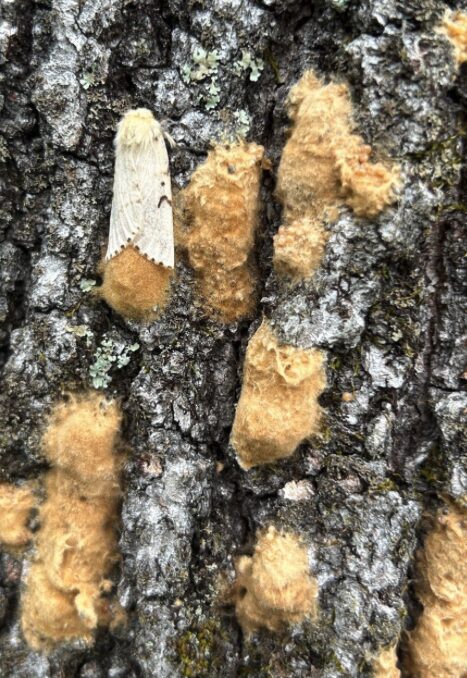
This is what a spongy moth infection looks like.  The moths (Lymantria dispar) aren’t native to North America.  They hitched a ride from Europe in the 1860s, landing in Massachusetts as an ill-fated silk-production experiment gone wrong.  Fast-forward to today: these devastating moths have spread across the Northeast, including our Western New York backyard, thanks to wind, vehicles, and unregulated firewood transport.

Spotting the Signs: What to Look For in Your Trees

     Early detection is your best defense.  Scout your oaks and hardwoods from late winter through summer.  Here’s what to hunt for:

     —  Look for “hairy tennis balls” on your trees or outdoor furniture.  These are egg masses that are glued to tree trunks and branches.

     —  Are caterpillars on the march?  In May-June, watch for 1-2 inch, fuzzy crawlers in black, yellow, blue, and white stripes.  They “rain” from trees on silk, creating eerie webs.  Check trunks at dusk when they’re most active.

      — Adult Moths:  July-August flights of beige females crawling (they don’t fly) and brown males fluttering signal breeding season.

     In Western New York, apps like iNaturalist or DEC’s pest tracker make reporting easy.  Snap photos and upload -– citizen science helps map outbreaks.

Prevention Best Practices: Keep Spongy Moths at Bay

     An ounce of prevention saves gallons of headache, and cash.  Start with vigilance:

     — Firewood Quarantine:  Never move untreated wood from infested areas.  Source local – “buy it where you burn it” is DEC’s mantra.  In 2024, this curbed spread from Pennsylvania into Chautauqua County.

     — Tree Banding:  In areas where infections have been found, wrap trunks with sticky bands or burlap in April to trap climbing caterpillars.  Refresh monthly.  It’s cheap and chemical-free.

     — Boost Natural Enemies:  Plant for predators – encourage birds like chickadees with feeders and native shrubs.  Parasitic wasps and fungi like “Entomophaga” naturally cull populations during wet springs.

     — Yard Cleanup:  Rake and destroy fallen leaves in fall to nix overwintering eggs.  Mulch around bases to deter soil-dwellers.

Treatment Tactics: From Sprays to Injections

     When prevention falls short, act fast –- timing is everything. 

     Biological controls 

     There is a biological insecticide you can purchase at Amazon or Home Depot called Bacillus thuringiensis var. kurstaki, known as BTK.  It is toxic to caterpillars but safe for humans, pets, birds, earthworms and bees.

     BTK is readily available and is marketed under several brand names, often as “BT” or “Bt kurstaki” products. Popular ones include:

• Monterey B.T.: A concentrate or ready-to-spray formula for home gardens.

• DiPel DF: A dry flowable powder, often used in larger-scale or organic farming.

• BT NOW: A water-based liquid concentrate for broad-spectrum caterpillar control.

• Captain Jack’s BT: A ready-to-use spray, bundled with tools for easy application.

• Safer’s BTK: A concentrate targeting common garden pests like cabbage worms.

     You don’t need a license to use it, but it’s important to read the directions carefully before applying it.  And timing is crucial.

     Chemical options

     For severe cases, your best bet is to have licenses professionals (like us!) inject the trees with an “EB” product.  This is “emamectin benzoate”, a semi-synthetic systemic insecticide derived from avermectin (produced by the soil bacterium Streptomyces avermitilis).  It’s highly effective against caterpillar larvae and other chewing insects that damage tree foliage, making it a go-to option for protecting high-value shade trees, ornamentals, and forest hardwoods from defoliation.

     EB is not typically available to the public so that’s why you need a state licensed applicator to apply it.  There is a new product anticipated to be approved in the Spring of 2026 called Agrilicide that promises to be very effective in targeting the spongy moth.  Again, give us a call if you suspect a spongy moth infection.

     Post-treatment, fertilize lightly and water deeply to aid recovery. Avoid over-pruning stressed trees.

Wrapping Up: Safeguard Your Oaks, Secure Your Sanctuary

     Spongy moths may seem like an unstoppable force, but knowledge is power.  By spotting signs early, preventing spread, and treating decisively, you can shield your oaks – and the web of life they support –- from this leafy apocalypse.  Western New York’s forests have weathered worse; with your help, they’ll thrive for generations.
19 Oct 2025

Expert Oak Tree Service and Care in Buffalo-Niagara: Safeguard Your Legacy Trees Today

     In the lush landscapes of Buffalo-Niagara, oak trees stand as timeless sentinels, providing shade, beauty, and ecological balance to our homes, parks, and communities. But a silent threat looms: oak wilt disease, a devastating fungal infection that’s already claimed millions of oaks across the Midwest and is inching closer to Western New York.

     As a dedicated provider of oak tree service and oak tree care, Saving Oaks is on the front lines, helping homeowners and property managers in Erie and Niagara Counties protect their prized trees.  We don’t cut oak trees down — we try to save them!  With proactive strategies and cutting-edge treatments, we’re committed to preserving the majestic oaks that define our Buffalo-Niagara region.
     If you’ve noticed wilting leaves or unexplained browning on your oaks, you’re not alone.  Oak wilt, caused by the fungus Bretziella fagacearum, spreads rapidly through root grafts, sap-feeding beetles, and contaminated tools or firewood.  Red oaks succumb in as little as four to six weeks, while even resilient white oaks can suffer long-term damage.  In Buffalo-Niagara, where dense urban forests meet rural woodlands, the risk is heightened by our proximity to confirmed cases in Southern Ontario — just across the Niagara River.

     But here’s the good news: Early intervention through professional oak tree care can prevent catastrophe.  At Saving Oaks, our oak tree service focuses on vaccination injections that deliver systemic fungicides directly into the tree’s vascular system, offering up to two to three years of robust protection.

Why Oak Tree Care Matters More Than Ever in Buffalo-Niagara

     The Buffalo-Niagara area’s unique microclimate — mild summers, snowy winters, and fertile soils — makes it a haven for oaks, from towering northern red oaks in Lewiston and Youngstown, to stately white oaks lining the streets of Niagara Falls and Buffalo.  These trees aren’t just aesthetic assets; they boost property values by up to 20%, reduce energy bills through natural cooling, and support local wildlife.

     Yet, as recent announcements from the New York State Department of Environmental Conservation (DEC) highlight, oak wilt is expanding eastward.  Infections in Niagara-on-the-Lake served as a stark warning for our region.
     Our family-owned business, Saving Oaks, understands these stakes intimately.  We are a state DEC licensed and registered family-owned business that specializes in oak tree care and services in the Buffalo-Niagara region.  Founded on a passion for arboriculture and sustainability, we’ve vaccinated hundreds of high-valued oaks across Niagara and Erie Counties, including Grand Island, North Tonawanda, Amherst, Tonawanda, and Buffalo proper.  Unlike traditional tree services that default to removal, our philosophy is preservation-first.  We employ the latest in tree injection technology — precise, environmentally safe methods that minimize soil disruption and maximize efficacy.  No sprays, no guesswork—just targeted defense against the fungus that clogs a tree’s water-conducting vessels.
     Recent blogs and updates on our site underscore the urgency.  For instance, our August 2025 post on “Protecting Your Oak Trees from Oak Wilt in Western New York” details how sap beetles thrive in spring wounds, turning minor prunes into infection gateways.  Similarly, our March analysis of “How Oak Wilt Spreads” reveals root graft dangers in clustered plantings, common in Buffalo-Niagara subdivisions.  These insights aren’t theoretical — they’re drawn from collaborations with Cornell Cooperative Extension and state forestry experts, ensuring our oak tree service aligns with the latest science.

Essential Tips for Superior Oak Tree Care on Your Buffalo-Niagara Property

     Empowering you with knowledge is core to our oak tree care approach.  Here are proven strategies to fortify your oaks against wilt, tailored for Buffalo-Niagara’s seasonal rhythms:

• Prune Timely and Wisely:  Never prune from April to July— that’s peak beetle season. Stick to the dormant window (November to February) to avoid attracting vectors.  If storms strike, seal fresh wounds immediately with latex paint or a commercial wound dressing.

• Break the Chain of Spread:  Root grafts can transmit the fungus up to 100 feet annually.  In high-risk areas like Wheatfield or Lockport, consider trenching 100 feet from infected trees.  Always source firewood locally and burn it on-site to prevent accidental transport.

• Monitor for Early Signs:  Watch for leaves browning from the outside edges and working inward, with leaves falling from the top of the tree first.  Or you may smell a sweet, fruity odor from bark slits — hallmarks of fungal mats.  Snap a photo and text it to us at 716-273-5522 for a free preliminary assessment.

• Vaccinating Your Trees is Less Expensive than Cutting Them Down:  Our flagship oak tree service — specially formulated fungicide injections — costs just $14 per inch of trunk diameter (measured at 4 feet above the ground).  A 20-inch oak?  That’s $280, with multi-tree discounts bringing it lower.  Compare that to thousands for removal and replanting.  Treatments are applied during the growing season for optimal uptake, providing a protective barrier that outlasts surface applications.  Vaccinations provide protection and stay effective for 2-3 years depending on the threat level in the future.

     These tips, echoed in our February 2025 announcement “Buffalo, NY, Oak Trees Threatened by Oak Wilt Disease,” have helped clients avoid potential losses.

The Future of Oak Tree Service: Innovation Meets Tradition in Buffalo-Niagara

     As oak wilt becomes more of a threat, we’re being pro-active, doing our best to be innovative and to get the word out.  Since diseases like oak wilt are fatal, prevention is the key.  Our latest news highlights partnerships with regional arborists, educating on susceptibility differences: fast-growing red oaks (Red, Pin, Black, Scarlet) versus slower, tougher white varieties (Bur, Swamp, White). We’re also expanding eco-friendly options, like bio-based sealants, to complement vaccinations.
     What sets our oak tree care apart?  It’s personal for us.  The “roots” of our family business started because of the concern we had for a magnificent 180 year old red oak tree that stands tall and proud in our backyard.  As a family operation rooted in Western New York, we treat every tree like our own. We’ve seen the heartbreak of ash borer devastation and refuse to let history repeat with oaks. Our licensed technicians undergo rigorous training, ensuring every injection is precise and pain-free for your trees.
     If your oak tree’s health is important to you, and you want to protect it with the best technology available, give us a call at 716-273-5522 today for a no-obligation consultation.  Whether you’re in the bustling heart of Buffalo or the serene shores of Lake Ontario in Olcott, our team serves the entire Buffalo-Niagara expanse.
     In Buffalo-Niagara, oaks aren’t just trees — they’re legacies.  Don’t wait for symptoms.  Partner with Saving Oaks for unmatched oak tree service and oak tree care. Together, we’ll keep our canopies thriving, one injection at a time.  Healthy Oaks, Happy Folks!

12 Aug 2025

Protecting Your Oak Trees from Oak Wilt in Western New York: Essential Tips for Youngstown, Lewiston, Niagara Falls, and Beyond

You can call or text us at: 716-273-5522

In the picturesque landscapes of Western New York, oak trees stand as timeless guardians of our properties, providing shade, enhancing property values, and supporting local ecosystems. From the neighborhoods of Youngstown and Lewiston to areas in Niagara Falls and Grand Island, these mighty oaks are more than just trees — they’re part of our heritage. 

However, a silent threat looms: oak wilt disease, a devastating fungal infection that’s already claimed millions of oaks across the Midwest and South. Trees in critical threat areas like Youngstown, Lewiston, Niagara Falls, and Grand Island face heightened risks due to proximity to confirmed cases just across the border in Ontario, it’s crucial to act now. This guide explores the dangers of oak wilt, its impact on other communities as well including Wheatfield, North Tonawanda, Buffalo, Tonawanda, and Amherst, and how professional services like those from Saving Oaks can help protect your high-valued oak trees.

Understanding Oak Wilt: A Deadly Threat to Your Oak Trees

Oak wilt is caused by the fungus Bretziella fagacearum, which invades a tree’s vascular system, blocking the flow of water and nutrients. This leads to wilting leaves, rapid defoliation, and, in many cases, the death of the tree. Red oaks, such as northern red, pin, black, and scarlet varieties common in Western New York, are particularly vulnerable, with a nearly 100% mortality rate once infected. Death can occur in as little as a few weeks to months. White oaks, including white and bur varieties, show more resistance but can still succumb, especially without early intervention.

The disease has wreaked havoc in over two dozen states, decimating urban and rural landscapes alike. Now, Western New York is on the frontline, with the fungus spreading from nearby areas in Canada, including Niagara Falls and Niagara on the Lake, Ontario. If left unchecked, oak wilt could transform the tree-lined streets of Buffalo, the suburban havens of Amherst and Tonawanda, and the rural charm of Wheatfield and North Tonawanda into barren vistas. Protecting your oak trees isn’t just about aesthetics — it’s about preserving the environmental and economic value they bring to our communities.

How Oak Wilt Spreads: Key Risks in Critical Threat Areas

Oak wilt spreads in two primary ways, making prevention essential for high-risk zones like Youngstown, Lewiston, Niagara Falls, and Grand Island. Above ground, sap-feeding beetles carry the fungus from infected trees to healthy ones, often attracted to fresh wounds from pruning or storm damage. Below ground, it travels through interconnected root systems, allowing it to jump from tree to tree in densely planted areas. Human activities exacerbate the problem: moving infected firewood or using contaminated tools can introduce the disease to new locations.

In critical threat areas such as Youngstown and Lewiston, where proximity to the Niagara River increases exposure to cross-border spread, residents must be vigilant. Niagara Falls and Grand Island, with their mix of urban parks and residential lots, face similar dangers, as confirmed cases in Ontario signal an imminent threat. Even in surrounding communities like Wheatfield, North Tonawanda, Buffalo, Tonawanda, and Amherst, where oak trees grace backyards and public spaces, the disease’s trajectory suggests rapid expansion if not addressed. Avoid pruning oaks during spring and summer — the peak season for beetle activity — and always seal wounds immediately with latex paint, especially after storms. These simple steps can make a significant difference in safeguarding your property.

Spotting the Signs: Early Detection in Western New York Communities

Recognizing oak wilt symptoms early is vital for protection. Look for leaves wilting and turning bronze or brown from the edges inward, starting at the tree’s top. Rapid leaf drop, dark streaks under the bark, and fungal mats emitting a sweet, fruity odor are telltale signs. In red oaks, symptoms progress quickly, while white oaks may show slower decline.

For homeowners in Youngstown, Lewiston, Niagara Falls, and Grand Island — areas under critical threat — regular inspections are highly recommended. The same goes for Wheatfield’s farmland fringes, North Tonawanda’s residential zones, Buffalo’s historic districts, Tonawanda’s suburban streets, and Amherst’s upscale neighborhoods. If you suspect infection, act fast. If a red or pin oak gets infected, there is no cure and the tree will die swiftly. It is important to cut those trees down immediately. White oaks are more resistant but can get infected too. Treatments with fungicide injections can help. Prevention is the key!

Prevention Strategies: Vaccinate Your Oak Trees Today

The most effective way to protect your high-valued oak trees is through preventative vaccination, a service expertly provided by Saving Oaks. This involves professional injections of a specialized fungicide that reduces infection risk or slows disease progression if exposure occurs. Treatments are recommended every 2 to 3 years, depending on threat levels, and are priced affordably at $14 per inch of trunk width (e.g., $280 for an oak tree that has a trunk that is 20 inches wide four feet above the ground) with discounts for treating multiple trees at once.

In critical areas like Youngstown, Lewiston, Niagara Falls, and Grand Island, where the disease is knocking at the door, vaccination is a proactive investment. Residents in Wheatfield, North Tonawanda, Buffalo, Tonawanda, and Amherst should also consider it, as the fungus’s spread knows no boundaries. Compared to tree removal costs, which can soar into thousands of dollars, vaccination is a cost-effective shield. We are a New York State DEC registered, licensed, and insured business based in Lewiston, specializes in this service, ensuring your oaks remain healthy and vibrant.

Additional tips include cleaning tools between trees, avoiding infected firewood transport, and planting diverse species to reduce root graft risks. By adopting these practices, you contribute to a healthier Western New York ecosystem.

The Benefits of Protecting Your Oak Trees: Economic and Environmental Wins

Healthy oak trees boost property values by up to 20% in areas like Amherst and Buffalo, where mature trees are prized features. They provide essential shade, reduce energy bills, and support wildlife, from birds to squirrels. In communities like Grand Island and Niagara Falls, oaks enhance tourism appeal, while in rural spots like Youngstown and Wheatfield, they maintain agricultural integrity.

Losing oaks to wilt not only diminishes beauty but incurs hefty removal and replacement costs. By partnering with us, you’re investing in long-term savings and sustainability. Our mission aligns perfectly with our region’s needs: “Healthy Oaks, Happy Folks!” — a reminder that protected trees lead to thriving communities.

Act Now: Save Your Oak Trees Before It’s Too Late

Don’t wait for oak wilt to strike your property in Youngstown, Lewiston, Niagara Falls, Grand Island, Wheatfield, North Tonawanda, Buffalo, Tonawanda, or Amherst. Call or text us today at 716-273-5522 to get a quote or to schedule a vaccination to protect your high-valued oak trees. And don’t forget to share this information with neighbors because collective action can halt the spread. Remember, prevention is key: Save your oaks before it’s too late!

11 Aug 2025

Oak Wilt: Protecting Buffalo’s Trees with Effective Tree Injection (vaccination)

Unlike other tree services, we don’t cut trees down — we try to save them!

Oak wilt is a destructive fungal disease that poses a serious threat to the beautiful oak trees in the Buffalo area. This fast-spreading infection can kill a healthy tree in just a few weeks. While the disease hasn’t been confirmed in Buffalo as of August 2025, it has been found just across the border in Ontario and south of Rochester, so it’s getting closer. The good news is that early detection and proactive treatment, such as tree vaccination, can save valuable oaks.

What is Oak Wilt and How Does it Spread?

Oak wilt is caused by the fungus Ceratocystis fagacearum. It enters a tree and clogs its water-conducting tissues, effectively cutting off its water supply. This leads to rapid wilting and death. The fungus primarily affects red oaks, which can die in a single season, while white oaks may decline more slowly over several years.

The disease spreads in a few key ways:

Root Grafts: The fungus can travel underground through interconnected root systems between nearby trees.

Beetles: Sap-feeding beetles can carry fungal spores from an infected tree to fresh wounds on a healthy one, especially from April to July.

Improper Pruning: Pruning oaks in the spring or early summer creates open wounds that attract these beetles, increasing the risk of infection.

Contaminated Tools: Fungal spores can be transferred from tree to tree on uncleaned pruning equipment.

How to Spot the Signs of Oak Wilt in Buffalo

Since early detection is crucial, it’s important to know what to look for. Keep an eye out for these signs of infection:

Sudden Wilting and Browning: Look for leaves that turn brown from the tips inward, starting from the top of the tree. Unlike seasonal changes, these leaves will often stay attached to the branches.

Fungal Mats: During Spring and Summer, you might see horizontal cracks in the bark. Underneath, a gray or brown fungal mat with a sweet, fruity smell (like Juicy Fruit gum) may be present, which attracts beetles.

Rapid Canopy Thinning: Red oaks will quickly lose their leaves at the top of the tree, with bare spots appearing and growing throughout the summer.

Distinctive Leaf Browning: Infected leaves brown from the edges inward toward the central veins, which is different from the uniform browning seen with drought or the spotted patterns of other diseases.

If you suspect your tree may have oak wilt, text us photos at 716-273-5522.

Why Tree Injection is the Best Treatment

When it comes to protecting your trees in Buffalo, tree injection is a superior method to traditional spraying. It’s a precise and effective way to deliver a protective fungicide (like propiconazole) directly into a tree’s vascular system.

Here’s why tree injection is the preferred method:

Targeted and Efficient: The fungicide is injected directly into the tree’s system, ensuring it reaches all parts of the tree and provides a strong, internal defense. Spraying only coats the surface and is less effective against a systemic disease like oak wilt.

Environmentally Friendly: Tree injection minimizes chemical drift, which reduces the risk to surrounding plants, animals, and water sources.

Long-Lasting Protection: A single injection can provide protection for 2-3 years, whereas sprays may wash away and need more frequent reapplication.

Weather-Independent: Tree injections can be performed in any weather, unlike sprays that are affected by wind and rain.

Safer for People and Pets: By avoiding airborne chemicals, injections reduce health risks for everyone on your property.

Work with Local WNY Experts

At Saving Oaks, our state-licensed applicators use a precise injection method using specially formulated fungicides designed to stop oak wilt in its tracks. We call it “tree vaccination” and that’s exactly what it is — a way to protect your valuable oak trees and landscape.  Our business is built entirely on protecting and preserving trees.

Don’t wait for oak wilt to strike. Be proactive and protect your oaks now.

To learn more about how to protect your trees from oak wilt or to schedule a quote, contact us today by calling or texting 716-273-5522.

17 Mar 2025
Effective Oak Wilt Treatments: How to Protect Your Trees

Effective Oak Wilt Treatments: How to Protect Your Trees

Oak wilt disease is a devastating fungal infection that threatens oak trees across the United States. If left untreated, it can quickly spread, killing entire groves of trees in just a few months. The best approach to managing oak wilt is early detection and preventative treatment. At SavingOaks.com, we specialize in tree vaccinations—the most effective way to prevent oak wilt and protect your trees before infection occurs.

Understanding Oak Wilt Disease

Oak wilt is caused by the fungus Bretziella fagacearum, which disrupts a tree’s ability to transport water and nutrients. It spreads through:

  • Root Grafts – Underground connections between oak trees allow the disease to transfer from one tree to another.
  • Sap Beetles – These insects carry fungal spores and introduce them to fresh wounds on oak trees.
  • Firewood Transport – Moving infected wood can spread oak wilt to new locations.

The Best Oak Wilt Treatments

While there is no cure for an infected red oak, there are several ways to manage and prevent the spread of oak wilt. The most effective methods include:

1. Tree Vaccination (Preventative Fungicide Injection)

Best for: Protecting healthy oak trees from infection.
Tree vaccinations involve injecting a systemic fungicide (such as propiconazole) directly into a tree’s vascular system, preventing oak wilt from taking hold. This is the most reliable method to protect high-value trees from infection. At SavingOaks.com, we specialize in preventative fungicide injections, ensuring your oaks stay strong and disease-free.

2. Trenching to Prevent Root Graft Transmission

Best for: Slowing the spread of oak wilt in infected areas.
By creating a trench around infected trees, you can break the underground root connections that allow the fungus to spread. This method is effective but labor-intensive and should be combined with other treatments.

3. Proper Tree Removal and Disposal

Best for: Preventing the further spread of the disease.
If a tree is already infected, removing it quickly can help stop oak wilt from spreading to nearby trees. It’s critical to properly dispose of infected wood—never transport or store diseased firewood.

4. Avoid Pruning During High-Risk Seasons

Best for: Reducing the risk of infection through fresh wounds.
Pruning during the growing season (April–July) creates open wounds that attract sap beetles, increasing the risk of infection. Always prune oaks during dormant seasons (fall and winter) to minimize exposure.

5. Apply Wound Sealant on Pruned or Damaged Trees

Best for: Protecting trees from beetle-borne infection.
If an oak tree sustains damage (from storms, pruning, or construction), applying a wound sealant immediately can help prevent fungal spores from entering the tree.

Why Choose SavingOaks.com for Oak Wilt Prevention?

At SavingOaks.com, we specialize in oak wilt treatments and specifically tree vaccinations, offering a proactive defense against oak wilt. Unlike general tree services, our focus is solely on preventative treatments, ensuring your oaks remain healthy for years to come.

Why Trust SavingOaks.com?

✔ Oak Wilt Prevention Experts – Specializing in science-backed fungicide treatments.
✔ Tree-Saving Approach – We focus on protecting trees, not removing them.
✔ Effective & Long-Lasting Protection – Our treatments safeguard oaks for up to two years.

Act Now to Protect Your Oak Trees

Oak wilt is a fast-moving, deadly disease, but early intervention and proper prevention can save your trees. The best time to act is before oak wilt appears in your area. Don’t wait until it’s too late—schedule a professional tree vaccination today at SavingOaks.com and keep your oaks safe from oak wilt!