Save Your Trees from the “Hemlock Woolly Adelgid”!
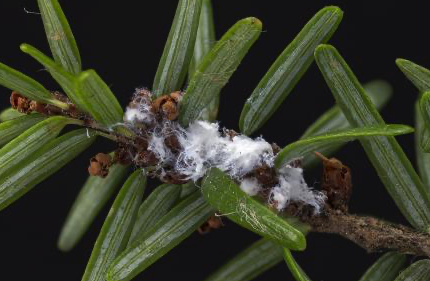
Recently, field teams from conservation groups in our region, including the Western New York Land Conservancy, have been closely inspecting hemlock trees on protected lands like those in East Aurora. During one survey, experts discovered the telltale white, woolly clusters on branch tips — clear evidence of hemlock woolly adelgid (HWA) — a tiny invasive pest that’s quietly but aggressively attacking hemlocks. (It’s pronounced uh-del-gid)
This sap-sucking insect, originally from Asia, has gradually expanded across much of New York since its first detection in the state decades ago. According to the New York State Department of Environmental Conservation, HWA now affects areas from the lower Hudson Valley westward through the Catskills and Finger Lakes, with more recent appearances in the Adirondacks and parts of western New York. The pest spreads via wind, birds, or human activity, moving roughly 10 miles per year in some areas.
In the Buffalo-Niagara region, infestations remain in early stages for many sites, meaning trees often show initial signs before widespread decline sets in. Conservation stewards note that while hemlocks in heavily affected zones farther east have turned brown and died off, local groves are still largely holding on — but the window for effective intervention is narrowing.
Hemlocks play a vital ecological role as keystone species. They thrive in shaded conditions where other trees struggle, forming dense stands that moderate temperatures, filter water, prevent erosion on slopes, and provide critical habitat for birds, mammals, amphibians, and understory plants. Mature eastern hemlocks, the primary species here, can live for centuries, with some reaching 800–1,000 years old. Losing them would dramatically alter forest dynamics, stream health, and biodiversity.
Insects Cause a Slow Death
As highlighted in a March 13, 2026, Buffalo News report, scientists emphasize the urgency: The adelgid can cause slow tree death by depleting stored nutrients, leading to needle drop, branch dieback, and eventual mortality. Foresters describe it as a major concern, noting hemlocks are not a species the state can afford to lose given their outsized importance.
Efforts to combat HWA include two primary strategies. Biological control deploys natural predators from the adelgid’s native range, such as the Laricobius nigrinus beetle (released since the 2000s in regions like the Finger Lakes and Catskills, with good establishment in some spots) and silver flies (introduced more recently, around 2015–2017, with ongoing monitoring for reproduction success). These predators feed on HWA eggs and nymphs, offering a long-term, self-sustaining solution. Releases have occurred in parts of western New York, but populations need time to build up sufficiently.
Get Your Hemlocks Vaccinated
In the interim, chemical treatments provide immediate protection for high-valued trees. Systemic insecticides, when properly applied, target the pest effectively and can serve both preventatively and therapeutically — even after early infection.
At Saving Oaks, we focus on this proven method for valuable individual or landscape hemlocks. We deliver direct trunk injections (we called them vaccinations) of Imicide (imidacloprid-based), a product with a long track record of success protecting hemlocks around the Great Lakes, including near Lake Michigan. (Michigan injects 50,000 hemlocks every year with Imicide.) This approach circulates the insecticide throughout the tree, reaching needles where adelgids feed, and offers 2 years of effective protection. This can be very useful when combined with another chemical called Dinotefuran.
These vaccinations must be administered by state-licensed pesticide applicators to ensure safety and compliance. Saving Oaks serves properties throughout Niagara and Erie Counties, helping homeowners, private estates, and conservation partners safeguard high valued trees before severe damage occurs.
If you own or manage a prized hemlock showing early white woolly spot, or want proactive protectio, reach out to Saving Oaks at 716-273-5522 for a professional assessment and quote. Our team will evaluate your trees and recommend a tailored plan.
It’s a Community Effort
Protecting hemlocks is a community effort. While hiking or exploring hemlock areas, look for those small white cottony masses on branch undersides. Photograph any suspects (include a scale like a coin for size reference), note the precise location, and email the photo and information to: foresthealth@dec.ny.gov
In warmer months, clean boots, gear, and pets after visiting infested sites to avoid unintentionally transporting the pest.
For detailed facts on identification, spread, and statewide efforts, check the DEC’s hemlock woolly adelgid resource page.
Our region sits at the advancing front of the infestation, making timely action especially impactful. While broad-scale biocontrol matures, protecting high-value hemlocks now preserves canopy cover, wildlife corridors, and scenic beauty for the future.
Hemlocks have long defined Western New York’s ravines, forests, and waterways. With combined vigilance, professional treatments, and emerging biocontrol, we can keep them thriving against this invasive threat.
Don’t wait for visible decline — contact Saving Oaks today and join the effort to protect Buffalo-Niagara’s hemlocks.
