Tree Diseases in Western New York: Threats, Therapies and Prevention Tips
We don’t cut trees down — we try to save them. And because tree diseases and invasive pests are a growing concern in Western New York, we keep busy.
Some threats, such as emerald ash borer, have already wiped out most of ash trees across the state. Others, including oak wilt, are moving uncomfortably close to the Niagara region. At the same time, hemlock woolly adelgid and beech leaf disease are spreading through parts of New York and putting important native trees at risk.
This guide will help you understand which trees are most vulnerable, what warning signs to watch for, and what practical steps homeowners can take to protect valuable trees before damage becomes severe.
The Most Serious Tree Threats in Western New York
• Oak Wilt
Oak wilt is one of the most dangerous tree diseases now threatening this region. It is caused by a fungus that blocks water movement inside the tree. Red oaks are the most vulnerable and can die within weeks to months, while white oaks usually decline more slowly over several years. Common symptoms include sudden wilting, browning that starts at the leaf edges and moves inward, and branch dieback that begins at the top of the canopy. In 2026, DEC expanded quarantine districts in Ontario and Yates Counties in the Finger Lakes region. Meanwhile, on the Canadian side of the border, oak wilt has been confirmed in Niagara Falls and Niagara-on-the-Lake At the time this blog was posted, Niagara and Erie Counties have no known reports of oak wilt infections. Our mission is to keep Niagara and Erie Counties free of oak wilt.
Prevention and Treatment: There is no cure for oak wilt, so prevention is everything. There are two things you can do to protect your oaks. First, don’t prune or trim your tree in the spring or summer. It will only attract sap beetles that spread the fungus. If your tree is storm damaged, be sure to immediately cover the wounds with latex paint. Second, get your high valued trees vaccinated that will provide 2-3 years of protection. Vaccination or injection services can only be performed by state licensed applicators. You can call us at 716-273-5522 or use the contact page here to get a quote.
The rate for vaccination (injection) services is $14 per inch of tree trunk width measured four feet above the ground. For example, if your tree trunk is 20 inches wide the cost would be $280. There are discounts for vaccinating multiple trees at the same time. Protecting a tree is usually less costly than having it cut down after it’s dead.
• Hemlock Woolly Adelgid
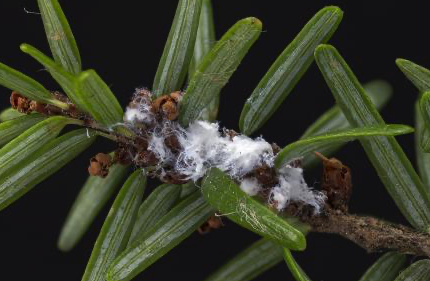
Hemlock woolly adelgid, often called HWA, is an invasive insect that attacks eastern (aka Canadian) hemlock, one of the most important native evergreens in New York. It can be recognized by tiny white, cotton-like masses on the underside of branches at the base of the needles. Infested trees often develop grayish needles, branch dieback, and thinning crowns, and many die within four to ten years if left untreated. DEC reports confirm HWA has spread into Western New York, with regional groups like the WNY Hemlock Woolly Adelgid Collaborative noting increasing abundance and ongoing survey/treatment efforts across the region.
Prevention and Treatment: For high-value landscape trees, early treatment can be very effective. We can inject your trees with specially formulated insecticides. Using that method insures that the trees are treated systemically, from top to bottom and inside out, without any external drift or runoff. It is safe for nearby plants and pets. These treatments can be protective for up to seven years. In the meantime, NY DEC has announced it is advancing its plans to release predator beetles that prey upon the Asian insect that causes Hemlock Woolly Adelgid.
You can see a WGRZ Channel 2 Report here. And a NY DEC info sheet here.
• Emerald Ash Borer
Emerald ash borer has already reshaped Western New York’s landscape. It was first discovered in New York state in 2009 and is now confirmed in nearly every county. Once infested, most ash trees die within two to four years. Typical warning signs include canopy thinning, bark splits, and the winding larval galleries beneath the bark. For ash trees that are still valuable and not too far gone, treatment may still be worth discussing with a certified arborist.
Prevention and Treatment: Insecticide vaccinations are a good option for protecting high-value ash trees, but dead or severely declining ash usually need removal instead. Homeowners should also avoid moving untreated firewood, which helps spread invasive pests.
• Beech Bark Disease and Beech Leaf Disease
American beech trees are now under pressure from two separate problems. Beech bark disease is an older disease complex caused by a scale insect plus fungal infection. DEC says it is common across New York State, and many trees die within about 10 years of infestation. Beech leaf disease is newer and especially concerning. DEC says it was first observed in New York in Chautauqua County in 2018 and has since spread through western, central, and southern New York. Symptoms include dark striping between the veins, curling, leathery leaves, reduced buds, and eventual decline.
Prevention and Treatment: Unfortunately, there are no cures. However, there are DEC approved products that while limited and experimental, can help suppress symptoms. They must be administered by licensed pesticide applicators. If you suspect a beech disease, please call us at 716-273-5522.
• Spotted Lanternfly
Spotted lanternfly is no longer a downstate-only problem. It has now been confirmed in Erie County and is a growing regional concern, especially for the Lake Erie grape belt, vineyards, fruit growers, and properties near tree-of-heaven (its preferred host). It feeds on many plants, including grapes, apples, hops, maple, walnut, and tree-of-heaven. This pest is especially important in Western New York because of the Lake Erie grape region. Homeowners should stay alert, follow current New York reporting guidance, and remove invasive tree-of-heaven trees since it is a preferred host.
You can learn more about tree-of-heaven here.
Other Tree Problems Homeowners Commonly See
Not every tree problem involves a catastrophic invasive pest. In wet or cool seasons, homeowners also see recurring issues such as anthracnose, powdery mildew, and various needle cast problems. Extension and DEC materials also regularly reference diseases such as cedar-apple rust, fire blight, diplodia tip blight, bacterial leaf scorch, Dutch elm disease, and chestnut blight.
How to Protect Trees in Western New York
The best defense is early vigilance and vaccinations where applicable. Learn what species you have on your property. Check them a few times each year for top-down dieback, sudden leaf drop, white woolly masses, unusual bark changes, or strange banding on leaves. Avoid pruning oaks during spring and summer, do not move untreated firewood, and call us at 716-273-5522 before a declining tree becomes hazardous or too damaged to save.
Western New York’s trees define the region, from gorge-side hemlocks to neighborhood maples and old oaks. A quick walk around your property can sometimes catch a serious problem early enough to act. And with tree diseases, early action is usually the difference between saving one tree and losing several.